
2026-10-08 · Technology
From brushes to a rotating field
What actually changes inside the motor when an RO booster becomes brushless — and what stays the same for the OEM.
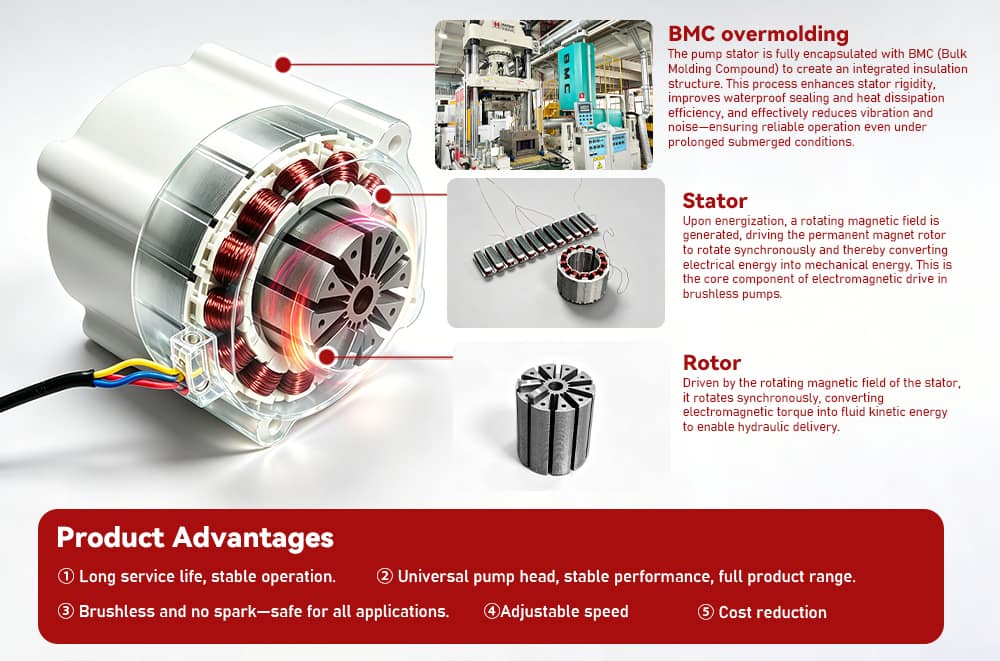
A diaphragm booster is two machines bolted together: a three- or five-chamber head that the industry already trusts, and a motor that has historically been a brushed permanent-magnet can. PEILI’s 605 brushless work keeps the first machine and replaces the second.
The electromagnetic side
Segmented coils are wound, formed into a ring, then overmolded in BMC. Energized, they produce a rotating field. The permanent-magnet rotor follows that field and takes the impeller with it. A thin isolation sleeve sits between the wet rotating group and the potted stator, which is how the motor claims a leak-free, IP68-class boundary.
The hydraulic side
Ports, mounting, and the 605 head geometry remain in the family PEILI already ships to first-line purifier brands. That is deliberate. The expensive part of a pump change for an OEM is rarely the motor — it is brackets, tubes, EMC, and re-validation. A shared head is the shortest path through that list.
The driver is part of the product, not an accessory afterthought: AC or high-voltage DC in, a rotating-field output to the motor, and 24/36 V available for neighbouring loads. Speed can be trimmed from an external signal so the same pump drawing can serve more than one SKU on the factory floor.