
2026-10-15 · Comparison / OEM
PEILI 605 vs Aquatec CDP 5900: longer life, stronger self-prime, no spark
The Aquatec CDP 5900 is a brushed 220/230 V RO booster. PEILI PL-605-1200WS does the same hydraulic job without carbon brushes: longer motor life, published self-prime, and no commutator spark. Working pressure is not higher — 150 psi vs listings near 160 psi.
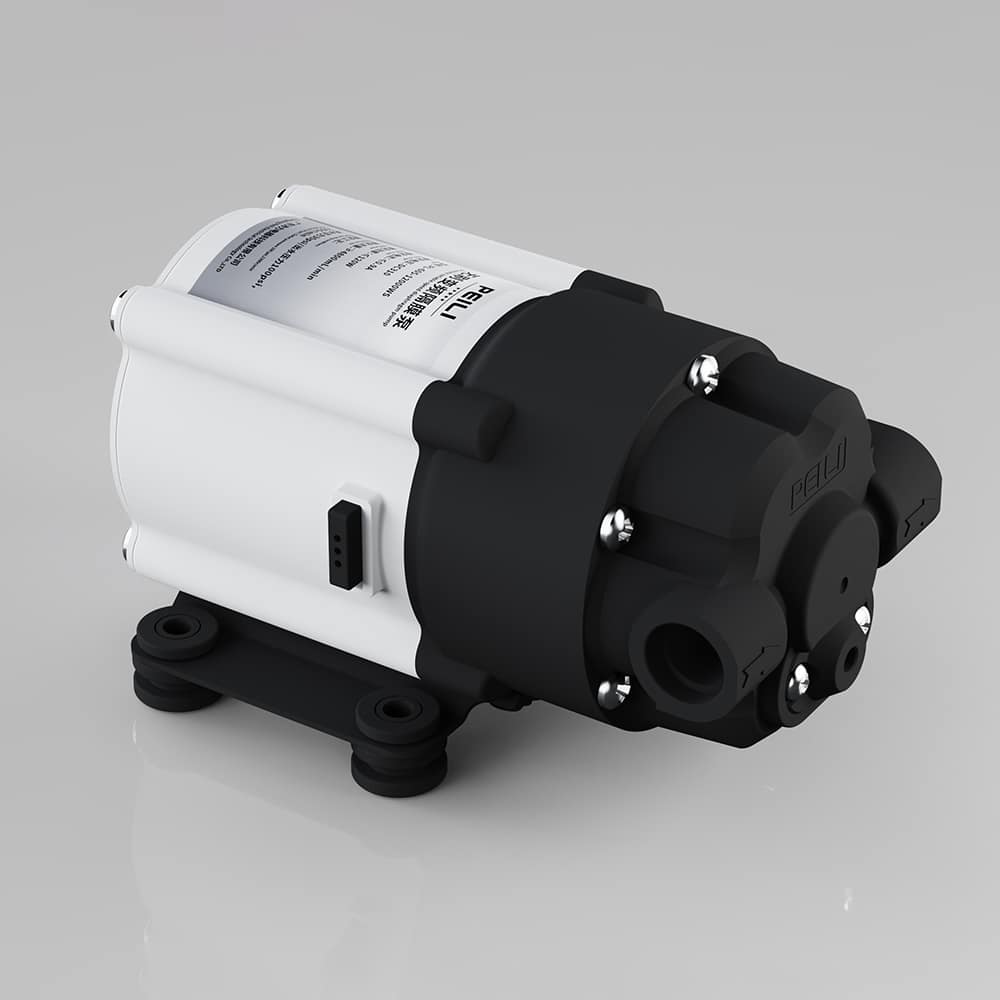
The Aquatec CDP 5900 is a brushed diaphragm booster that European RO and dispenser OEMs already know: 220/230 V, about 4.2 L/min, bypass near 135 psi, max outlet listed around 160 psi (11 bar). PEILI PL-605-1200WS is a brushless, variable-speed diaphragm pump for the same class of reverse-osmosis and commercial water chassis: AC 115 V / 230 V, rated flow ≥ 4.8 L/min, flow range 2.5–7.5 L/min at 100 psi, outlet max 150 psi. The 605 does not win on nameplate pressure. It wins on three published facts: no carbon-brush wear, strong self-prime and suction on the 605 head, and no commutator spark.
Side by side
CDP 5900 figures below follow Italian distributor listings for the 220/230 V model. PEILI figures are the published PL-605-1200WS nameplate. This is not a lab shoot-out.
| Topic | Aquatec CDP 5900 (listed) | PEILI PL-605-1200WS |
|---|---|---|
| Motor | Brushed (carbon brushes) | Brushless rotating field — no brushes, no spark |
| Supply | 220/230 V, 50/60 Hz | AC 115 V / 230 V; DC 24/36 V driver kits also exist |
| Flow | About 4.2 L/min (1.10 gpm) | ≥ 4.8 L/min; 2.5–7.5 L/min at 100 psi, set from the driver |
| Outlet | Listed max ~160 psi / 11 bar | Max 150 psi / ~10.3 bar — not a higher-pressure pump |
| Power | Listed ~110 W | ≤ 120 W, ≤ 0.9 A |
| Speed | Fixed by winding and voltage | External signal on the multi-function driver |
| Life limiter | Carbon brushes and commutator | No brush set; wet end type-tested 3.5 MPa burst, 1.2 MPa × 120,000 water-hammer cycles |
| Prime / suction | Diaphragm booster, as listed by the brand | Published strong boost and self-prime, high suction on the 605 head |
Lifetime: the brush is the wear part
A CDP 5900-class motor commutates on carbon brushes. Those brushes are a scheduled wear item. When they are gone, the motor is gone, even if the diaphragm head is still good. PL-605-1200WS has no brush contact. Service life of the electromagnetic side is no longer set by a carbon stick. The wet end is still qualified as a mechanical part: Jiangmen bursts it at 3.5 MPa and runs 1.2 MPa water hammer for 120,000 cycles, then a life bench. Every serial unit still sees nine outgoing tests. Longer life here means the motor is not the first part to die. It does not mean a diaphragm never wears.
Self-prime: tank feed and weak inlet
Many 5900 installations sit on a city main. Tankless RO, dispensers, RVs and yachts often sit on a tank or a weak riser. PEILI publishes high pressure and suction on the 605 platform — strong boost and self-prime for RO, dispensers, commercial loops, and onboard fresh-water systems. That is the hydraulic claim, not a higher 160 psi stamp. Outlet max stays 150 psi. If the chassis needs lift off a tank, ask for the 605 self-prime behaviour on that inlet, not a CDP 5900 bypass setting.
No spark: safer in the cabinet
Brushed commutators spark. The 605 does not: there is no carbon-brush contact. For an ordinary under-sink RO that is tidier — no brush dust. For an ice-machine water circuit next to flammable R600, it is the published safety point: a brushless pump that can be used in ice-machine water purification because it does not spark. PEILI does not publish an ATEX certificate. Spark-free is a motor fact, not a licence to ignore the ice-machine standard you ship.
What stays the same for the OEM
Both machines are diaphragm boosters for RO and dispensers. Changing a 5900 is rarely about finding 20 psi more. It is about brushes, spark, and a motor that dies first. The 605 keeps a 605-family pump head so ports and mounting can stay close to an existing layout. The driver is part of the BOM: AC 115/230 V, or a DC 24/36 V bus, with speed as a control input. Send voltage, target flux and annual volume if you are mapping a 5900 footprint — the answer is a driver kit plus this nameplate, not a claim that 150 psi beats 160 psi.
Is the PEILI 605 a replacement for an Aquatec CDP 5900?
It is a brushless alternative for the same job: boosting reverse-osmosis and light-commercial water systems. PL-605-1200WS is rated AC 115 V / 230 V, ≥ 4.8 L/min, outlet max 150 psi. Distributor listings for the 220/230 V CDP 5900 cite about 4.2 L/min and max outlet about 160 psi. The published difference is not more pressure. It is no carbon brushes, no spark, variable speed, and self-prime on the 605 head.
Why does a brushless RO booster last longer than a CDP 5900-class pump?
A CDP 5900-class booster uses a brushed motor. Carbon brushes wear and that wear ends motor life. PL-605-1200WS has no brush set. The rotating field has nothing to grind away. The wet end is still a diaphragm head; PEILI type-tests it at 3.5 MPa burst and 1.2 MPa water hammer for 120,000 cycles.
Is the PEILI 605 safer than a brushed Aquatec booster because it has no spark?
The brushless motor has no carbon-brush contact, so there is no commutator spark. That matters in cabinets with flammable R600 ice-machine charges, where PEILI publishes the pump for ice-machine water purification. No ATEX certificate is published. Outlet max remains 150 psi; do not treat spark-free as a higher-pressure claim.