
2026-10-13 · Technology / Comparison
Brushless vs brushed: what changes on an RO booster
A brushless RO booster is still a diaphragm pump. The difference is commutation: no carbon brushes, speed set from the driver, and the same 605 head.
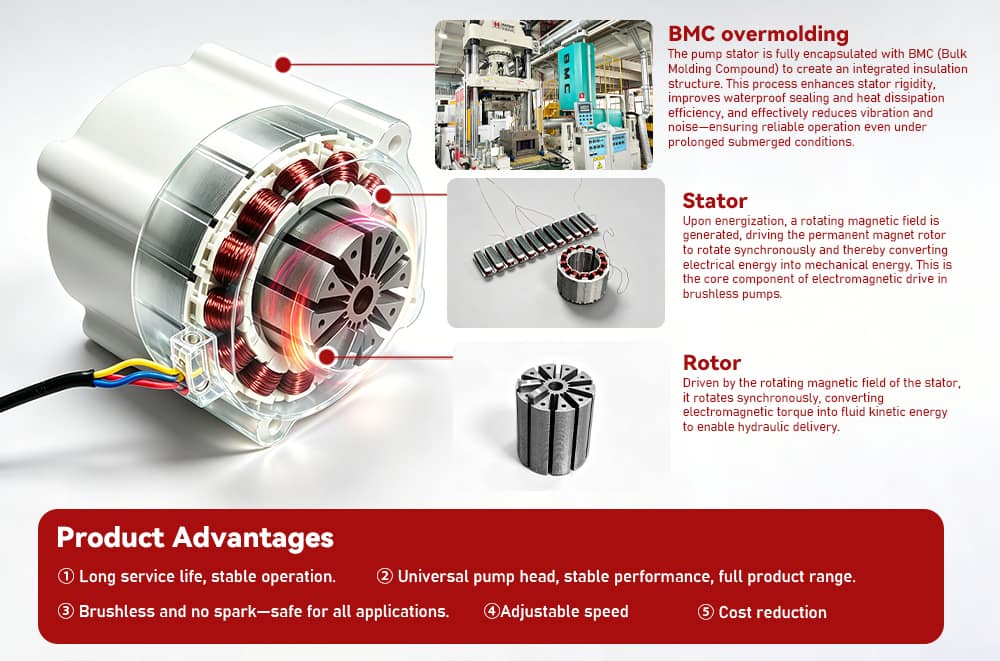
A brushless RO booster pump is a diaphragm pump whose motor is driven by a rotating magnetic field instead of carbon brushes. On the PEILI 605, that definition is concrete: model PL-605-1200WS, AC 115 V / 230 V, rated flow ≥ 4.8 L/min, outlet max 150 psi, BMC-encapsulated stator, and the existing 605 pump head.
What stays, what changes
- Commutation: carbon brushes on a conventional booster; an electronic rotating field on the 605.
- Spark: present at a brushed commutator; none when there is no brush contact.
- Speed: fixed by winding and voltage on a brushed motor; adjustable from the driver on the 605.
- Wear parts: brushes and commutator versus no brush set.
- Pump head: both use the 605 family. Ports and mounting can stay.
- System BOM: a brushed unit is typically pump plus adapter; the 605 is pump plus a multi-function driver.
The driver is part of the answer
Three kits cover the 605 head. A DC 24 V / 36 V bus input for systems that already have that rail. An AC 115 V / 230 V input with no external adapter and a 24/36 V auxiliary output. The same AC input with an external speed signal, so one pump drawing can serve more than one flow and pressure SKU. The comparison table and the rated point are published at /faq.