
2026-10-14 · Manufacturing / Quality
How PEILI tests a brushless diaphragm pump: 3.5 MPa burst, 120,000 water-hammer cycles
Jiangmen’s comprehensive stand qualifies the BMC brushless variable-speed pump and the 380 V high-pressure pump on one protocol: 3.5 MPa burst, 1.2 MPa water hammer for 120,000 cycles, and a life bench — then every unit still goes through nine outgoing tests.
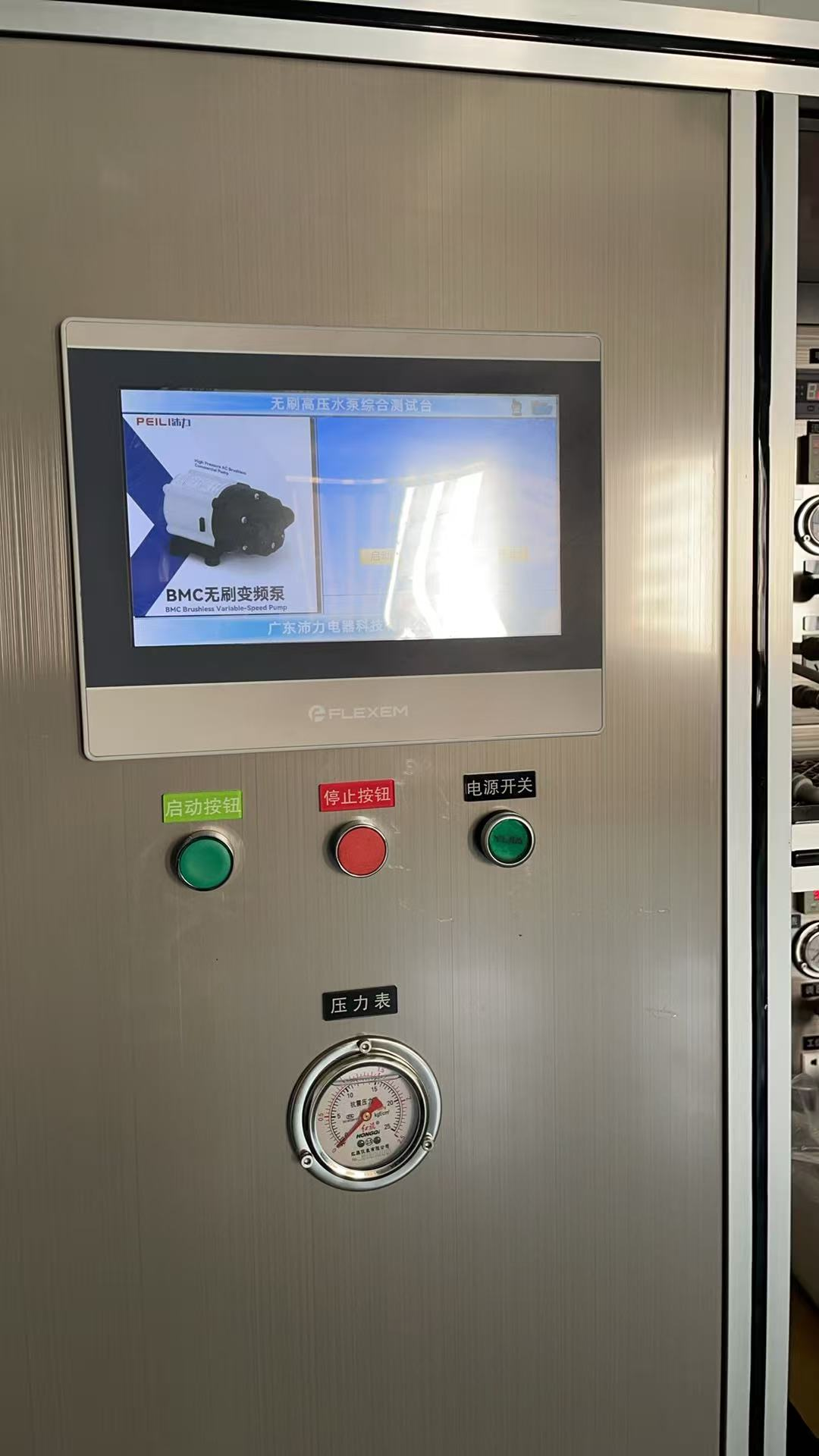
A factory type test on a PEILI brushless diaphragm pump is not the nameplate rating. The released model, PL-605-1200WS, is a BMC brushless variable-speed diaphragm pump for reverse-osmosis and commercial water systems: AC 115 V / 230 V, rated flow ≥ 4.8 L/min, outlet max 150 psi. Before that drawing ships, the Jiangmen plant bursts the wet end at 3.5 MPa (about 35 bar / 508 psi), then runs a 1.2 MPa water-hammer test for 120,000 cycles and a life bench. The same comprehensive stand also qualifies the 380 V high-pressure brushless pump shown beside it on the HMI.
The brushless high-pressure comprehensive stand
The cabinet in the plant is labelled a brushless high-pressure water pump comprehensive test bench. The HMI is a FLEXEM panel. Start, stop and mains sit in a row above an analogue pressure gauge. The screen holds two products: on the left, the BMC brushless variable-speed pump (the 605 platform, model PL-605-1200WS); on the right, the 380 V high-pressure brushless pump. The legal name on the header is Foshan Peili Electrical Technology Co., Ltd. Type testing for both drawings runs here; volume assembly and the nine outgoing benches sit on the same Jiangmen campus in Shenjiang Industrial Park, Xinhui.
3.5 MPa burst — not the 150 psi nameplate
Outlet max 150 psi on PL-605-1200WS is about 10.3 bar or 1.03 MPa. That is the working ceiling the OEM designs around. The type-test burst is 3.5 MPa — about 35 bar or 508 psi, more than three times the nameplate. The question the bench asks is whether the 605-family head, diaphragm and joints hold without rupture or leak, not whether the pump should be sold as a 3.5 MPa machine.
- Nameplate (PL-605-1200WS): outlet max 150 psi / ~10.3 bar / ~1.03 MPa.
- Type-test burst: passed 3.5 MPa / ~35 bar / ~508 psi.
- Applies to the BMC variable-speed pump and the 380 V high-pressure pump on this stand.
Water hammer: 1.2 MPa, 120,000 cycles
A reverse-osmosis or commercial cabinet does not run at a steady outlet. Inlet valves and tank switches slam. Water hammer is that spike. PEILI runs a 1.2 MPa water-hammer test for 120,000 cycles on this wet-end family. After the count, leak, flow and pressure are read again. A brushless motor does not remove the hydraulic hit — it removes carbon-brush wear — so the head still has to survive the cycle count on its own.
Life bench, then nine outgoing tests
Life testing is an endurance run under load: the assembled pump stays on the bench while leak, flow, pressure hold and noise are watched. There is no carbon-brush set to grind away, which is why the platform claims a longer motor life; the wet end is still qualified as a mechanical part. That type work does not replace 100 percent outgoing inspection. Every unit still goes through the nine benches already published for the Jiangmen line.
- Air tightness
- Mechanical properties
- Flame retardance
- Flow performance
- Noise
- Pressure
- Load
- Hot / cold
- Material reliability
Electrical, sealing and hydraulic data are stored per unit on the automated water test stand. Incoming inspection and in-process checks sit upstream of that. R&D and the anechoic chamber remain in Beijiao, Shunde; rotors are made in-house at Jiangmen Peili Chiyang Motor. The plant runs under ISO 9001:2015. Published marks on the product line include CE, RoHS, REACH, CQC and food-grade wetted parts.
What this means for an OEM
The expensive part of changing an RO booster is rarely the motor. It is brackets, tubes, EMC and re-validation. The 605 brushless platform keeps the pump-head family, so burst and water-hammer work already behind that head still apply. The comprehensive stand is how PEILI shows the BMC variable-speed pump and the 380 V high-pressure pump were taken through the same hydraulic punishment before a chassis engineer has to. Rated voltage, flow and 150 psi stay on the nameplate; 3.5 MPa burst and 1.2 MPa / 120,000-cycle hammer stay in the factory protocol. If you are qualifying a new drawing, send voltage, target flux and annual volume — the map is a driver kit plus this test record, not a one-line quote.
What burst pressure does PEILI test on a brushless diaphragm pump?
The wet end has passed a 3.5 MPa burst test (about 35 bar / 508 psi). That is not the working pressure. PL-605-1200WS remains rated at outlet max 150 psi (about 10.3 bar / 1.03 MPa).
How many water-hammer cycles does PEILI run?
The protocol is a 1.2 MPa water-hammer test for 120,000 cycles on the same pump-head family. After the count, leak, flow and pressure are checked again. The test sits on the brushless high-pressure comprehensive stand in Jiangmen, for the BMC variable-speed pump and the 380 V high-pressure pump.
Does a 3.5 MPa burst test change the 150 psi nameplate?
No. 150 psi is the published outlet maximum for PL-605-1200WS. The 3.5 MPa burst is a qualification of the head, diaphragm and joints — more than three times the nameplate — so a cabinet that slams a valve does not become the first time the wet end sees a spike.